
Choosing the right childcare center is one of the most important decisions parents make. A daycare center becomes more than just a place where children spend time while parents work; it serves as an environment where young minds grow, learn, socialize, and build the foundation for future success.
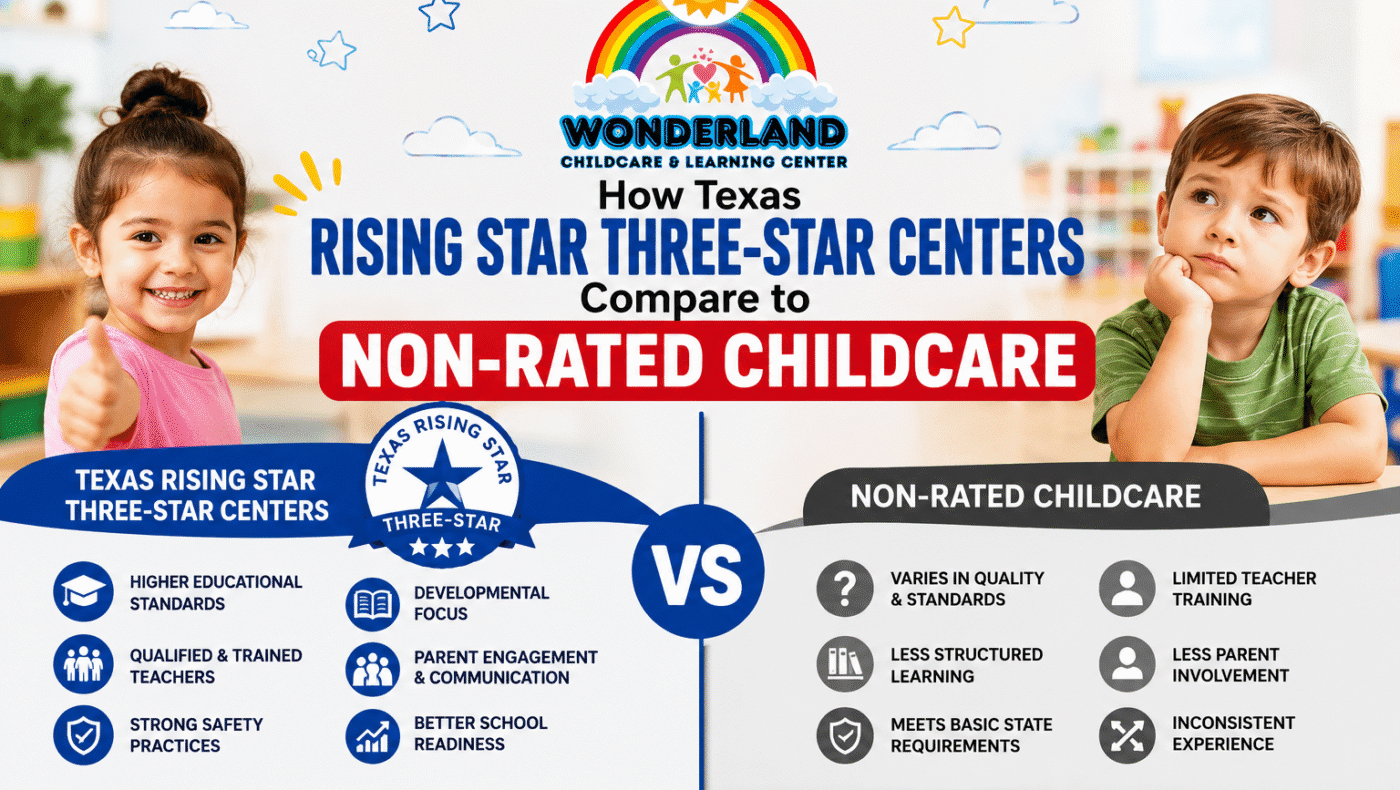
Parents in Texas often come across the Texas Rising Star (TRS) certification when searching for quality childcare options. While many daycare facilities meet state licensing requirements, not every center participates in quality-rating systems. This creates an important question for families: How does a Texas Rising Star Three-Star center compare to a non-rated childcare center?
Understanding the differences between these childcare options can help parents make informed decisions that align with their expectations and their child’s developmental needs.
In this article, we will explore the key differences between Texas Rising Star Three-Star centers and non-rated childcare programs across important areas including educational quality, teacher qualifications, safety standards, learning environments, child development, and long-term benefits.
Understanding Texas Rising Star Certification
Texas Rising Star is a quality improvement and rating system designed to identify childcare providers that exceed basic state childcare licensing standards.
The program evaluates centers using strict criteria that include:
- Staff qualifications
- Teacher-child interactions
- Learning environments
- Parent engagement
- Child development support
- Curriculum quality
- Administrative practices
Centers receive ratings ranging from:
- Two-Star
- Three-Star
- Four-Star
A Three-Star childcare center demonstrates a high level of quality and commitment to children’s development.
Non-rated childcare centers, on the other hand, may still be legally licensed and operate within state regulations but have not undergone the additional Texas Rising Star evaluation process.
Basic Licensing vs Enhanced Quality Standards
One of the largest differences between a Texas Rising Star Three-Star center and non-rated childcare is the level of standards each follows.
Non-rated childcare centers
These centers typically meet state minimum licensing requirements, including:
- Health regulations
- Safety standards
- Staff background checks
- Basic caregiver qualifications
Meeting these standards allows centers to legally operate.
However, basic licensing often focuses on minimum requirements rather than enhanced educational quality.
Texas Rising Star Three-Star centers
Three-Star centers go significantly beyond basic standards by demonstrating excellence in:
- Child learning experiences
- Classroom interactions
- Teacher education
- Parent involvement
- Child development practices
Rather than simply meeting requirements, these centers actively pursue higher-quality care.
Teacher Qualifications and Training
Teachers play one of the most important roles in early childhood development.
The differences in staff training between Texas Rising Star Three-Star centers and many non-rated facilities can be substantial.
Texas Rising Star Three-Star centers
Teachers generally receive:
- Ongoing professional development
- Specialized early childhood education training
- Child development instruction
- Behavioral management education
- Enhanced classroom teaching skills
Professional growth remains an ongoing process.
Non-rated childcare centers
Requirements may vary widely.
Some non-rated centers employ highly skilled educators, while others may only meet minimum state requirements.
Potential limitations may include:
- Limited continuing education
- Fewer training opportunities
- Less emphasis on developmental learning strategies
Consistency often differs significantly among non-rated facilities.
Curriculum and Learning Experiences
Parents increasingly expect daycare centers to provide educational opportunities rather than simple supervision.
This is another area where Texas Rising Star centers often stand apart.
Texas Rising Star Three-Star programs
Learning experiences are structured around developmental goals.
Activities may include:
- Reading sessions
- Literacy exercises
- Music and movement
- Early math skills
- Creative arts
- Science exploration
- Problem-solving activities
Programs intentionally support age-appropriate development.
Children learn through play while developing critical thinking skills.
Non-rated childcare programs
Educational quality varies considerably.
Some centers may offer strong learning activities, while others focus primarily on supervision and free play.
Children could experience:
- Less structured learning
- Limited educational planning
- Reduced developmental assessments
Because no formal quality rating exists, parents often need to investigate learning standards themselves.
Classroom Environment Comparison
Children spend many hours in daycare environments.
Classroom quality directly affects behavior, learning, and emotional development.
Texas Rising Star Three-Star classrooms
Classrooms are often designed to encourage:
- Exploration
- Creativity
- Social interaction
- Independence
- Safe movement
Centers typically include:
- Learning stations
- Reading corners
- Sensory activities
- Age-specific educational materials
Environments are carefully organized to support learning goals.
Non-rated childcare classrooms
The classroom environment can vary widely depending on management decisions.
Some may provide exceptional learning spaces while others may have:
- Limited educational resources
- Less organization
- Fewer developmental materials
Quality differences become difficult to predict without visiting the facility.
Teacher-to-Child Ratios
The amount of individual attention children receive matters greatly.
Texas Rising Star programs frequently maintain better teacher-to-child ratios than minimum state requirements.
Benefits of lower ratios include:
- Increased supervision
- More individualized learning
- Stronger emotional support
- Better communication
- Faster identification of developmental concerns
Children often thrive when teachers have time to focus on individual needs.
Non-rated centers
Some non-rated providers may follow only required minimum ratios.
Higher group sizes can sometimes result in:
- Less personalized attention
- Reduced interaction
- More classroom distractions
However, this can vary from center to center.
Child Development Support
Quality childcare focuses on the whole child.
Development includes multiple areas:
- Cognitive growth
- Emotional health
- Physical development
- Social skills
- Language abilities
Texas Rising Star Three-Star centers
Developmental support is intentional and ongoing.
Teachers observe children’s progress and adapt activities accordingly.
Programs encourage:
Language development
Children build vocabulary and communication skills.
Social development
Children practice teamwork and sharing.
Emotional development
Children learn emotional awareness and self-regulation.
Physical development
Activities improve coordination and motor skills.
Non-rated childcare centers
Developmental practices depend heavily on individual providers.
Some may have strong systems in place, while others may not formally track growth.
Parent Communication and Engagement
Parents want to remain actively involved in their child’s progress.
Communication quality often differs between rated and non-rated centers.
Texas Rising Star Three-Star centers
Parent involvement receives significant emphasis.
Communication methods often include:
- Progress reports
- Parent meetings
- Daily updates
- Family events
- Mobile communication tools
Parents become active partners in the learning process.
Non-rated childcare centers
Communication practices vary.
Some provide excellent updates, while others may offer only basic information.
Possible limitations include:
- Less frequent reporting
- Limited family involvement
- Reduced developmental discussions
Safety and Health Standards
Safety is always a top priority.
Both Texas Rising Star centers and licensed non-rated centers must follow state safety requirements.
However, Three-Star centers frequently exceed minimum expectations.
Texas Rising Star Three-Star safety practices
These may include:
- Enhanced supervision procedures
- Organized emergency plans
- Child-safe classroom layouts
- Routine safety reviews
- Strong sanitation procedures
Non-rated childcare facilities
Minimum requirements are generally followed.
Quality beyond basic standards varies among providers.
Parents should always ask questions regarding:
- Security systems
- Emergency procedures
- Health policies
- Cleaning routines
School Readiness Comparison
Parents want children to enter kindergarten prepared and confident.
School readiness extends beyond knowing letters and numbers.
Children also need:
- Listening skills
- Independence
- Communication abilities
- Social interaction skills
- Problem-solving abilities
Texas Rising Star Three-Star centers
Programs intentionally prepare children for future academic environments.
Children become familiar with:
- Structured schedules
- Group learning
- Instruction-following
- Classroom expectations
Non-rated childcare programs
School readiness preparation can differ significantly.
Some programs emphasize academics while others focus primarily on childcare.
Consistency in Quality
One challenge parents face with non-rated childcare involves predicting quality.
Texas Rising Star Three-Star centers
Centers undergo evaluations and must maintain performance standards.
This creates more consistency across important areas.
Parents often know they can expect:
- Structured learning
- Qualified teachers
- Child-centered environments
- Development-focused programs
Non-rated centers
Experiences vary widely.
Some provide excellent care while others may only satisfy minimum requirements.
Without quality assessments, parents rely heavily on:
- Reviews
- Recommendations
- Personal observations
Long-Term Benefits for Children
Research continues to show that quality early education influences future outcomes.
Children who receive strong early learning experiences often demonstrate:
- Better academic performance
- Stronger communication skills
- Improved social behaviors
- Greater confidence
- Better emotional management
Texas Rising Star Three-Star programs are designed specifically to strengthen these developmental foundations.
While non-rated childcare can still provide positive experiences, quality may be less predictable.
Cost Differences
Many parents naturally consider cost when comparing childcare options.
Three-Star centers may sometimes cost more because they invest in:
- Staff training
- Educational resources
- Quality improvement efforts
- Classroom materials
- Enhanced programming
However, families often view these costs as an investment in long-term child development.
Some non-rated centers may offer lower tuition rates.
Parents should consider overall value rather than cost alone.
Lower prices do not automatically mean lower quality, but understanding what services and developmental support are included is important.
Questions Parents Should Ask During Childcare Visits
Regardless of whether a center is rated or non-rated, parents should ask important questions before making a decision:
- What curriculum do you use?
- How are teachers trained?
- How are behavioral issues handled?
- How do you communicate with parents?
- What safety procedures are in place?
- How do you monitor child development?
- What are your teacher-to-child ratios?
Observing classrooms can also provide valuable insight into daily operations.
Watch for:
- Happy and engaged children
- Positive teacher interactions
- Clean environments
- Organized learning areas
- Structured activities
Final Thoughts
Choosing between a Texas Rising Star Three-Star center and a non-rated childcare provider ultimately depends on a family’s priorities, budget, and expectations.
Texas Rising Star Three-Star centers offer a more structured and quality-focused environment by exceeding basic childcare standards. They emphasize educational development, trained staff, parent involvement, and consistent quality practices.
Non-rated childcare providers can still offer excellent care, but quality often varies because they are not evaluated through additional quality measurement systems.
For parents seeking confidence in educational quality, child development support, and a nurturing environment, a Texas Rising Star Three-Star center often provides advantages that extend well beyond everyday childcare.
Investing in quality early childhood experiences can help create a stronger foundation for lifelong learning and future success.